Smooth and Striated Spacetime

Thanks especially to Benoît Le Bouteiller and Antonella Marreiros for their help in the preparation of this essay.
In his Darmstadt lectures, the composer and conductor Pierre Boulez presented a framework for conceptualizing musical space and time based on the interplay of two countervailing properties which he referred to as the smooth and the striated.1 This schema was later taken up by Deleuze and Guattari, who expanded its scope well beyond the terrain of musical form, treating the smooth and the striated as contrasting propensities at work in a wide array of phenomena.23 For some time now I have been using these notions in my clinical practice. In this essay, I hope to introduce the concepts of smooth and striated space and time—beginning at their point of origin in Boulez’s music theory—and then explore some of their possible applications in a clinic oriented by the topological paradigm of the late Lacan.
For those without a strong grounding in music theory, the only prior conceptions needed for understanding Boulez’s paradigm are the following:
Pitch is the property that tells us how relatively high or low a musical tone is. A higher pitch (think of the chirping of birds, the flutes in an orchestra, or the whistling of winds through an open terrain) corresponds to a higher frequency—that is, a faster oscillation of the sound wave. A lower pitch (think of the bass in a jazz or rock band, the rumbling of a thunderstorm, or maybe a whale’s song) corresponds to a lower frequency / slower oscillation. Pitch and note, though not identical concepts on a technical level, are often used interchangeably (including in this essay).
Interval is the measure of the difference between two pitch frequencies. A very high pitch and a very low pitch would have a relatively large interval, while two higher pitches, for instance, would have a smaller interval. We tend to conceptualize an interval as representing the “distance" between two notes.
Pitch space is the abstract terrain in which musical sounds emerge and interact, producing the various effects that constitute essential elements of musical form (i.e. melody, harmony, etc.). There are varying maps and models used to represent the spatial world of musical pitch.
In putting forward the concepts of the smooth and the striated, Boulez is trying to conceptualize a principle of musical “relativity.” As he points out, in actual fact there isn’t a single pitch space, but rather an inexhaustibly large set of possible musical worlds. Each of these unique spaces can be characterized by the particular manner in which they subdivide the spectrum of pitch frequencies. The system that has predominated in the Western world—based as it is on the interval of the octave, which is then subdivided into a scale of 12 pitches, each separated by the interval of a half step or semitone—is only one such way to delineate a musical space.
To refer to the subdividing of pitch space, Boulez uses a rather strange term: striation. This word has certain applications in the natural sciences, but to my knowledge, Boulez is the first to employ it in a musical context. In geology, striations are the grooves or furrows that we often observe on the surfaces of rocks or minerals, producing the effect of segmentation and differentiation in what would otherwise be a seamless continuity. If the connection to music seems obscure, simply picture a piano. Notice that the surface of its keyboard is segmented into separate components (the 88 keys, each of which produces a distinct pitch frequency). The structure of the keyboard—like the striated surface of a rock—offers us a clear and concrete representation of a striated musical space.
Now let’s do a thought experiment: picture the keyboard again, but with more than 88 keys. In fact, make it many, many more—but still contained within the same space. In reality, it doesn’t matter if our augmented piano is the same size, but for conceptual purposes, it might help to imagine all those added keys having to become very small in order to be scrunched into the same keyboard space. What does this picture represent? This is another kind of striated pitch space, one wherein the intervals between pitches would be far smaller. This means that within the same overall sound environment (that is, the same spectrum of pitch from low to high) we would have a lot more sonic possibilities than in our standard 88-key piano. Those pitch frequencies that we can’t get on the standard instrument (the ones that fall between the cracks, as it were)? Well, we’d be able to play a lot more of those.4
The crucial point to grasp about striation is that no matter how many subdivisions are created, our pitch space will always be a set of discrete elements (that is, distinct and separable locations along the spectrum of pitch). No matter how fine-grained our structure becomes, there will be gaps—unrealizable pitch frequencies that fall between the cracks.
In a second contrasting thought experiment, we can remove the keys entirely and generate a radically different kind of pitch space. In this imaginary scenario, it might be helpful to picture the surface of the keyboard having been transformed into a unified whole, without any subdivisions. Even though we have removed its striations, it still constitutes a pitch space. What does this mean? Well, if we were a small insect walking along this surface, we would find that wherever our little legs stepped, a sound would be produced. In this sonic world, there is a practically infinite set of possible pitch frequencies. The matter becomes clearer if we imagine ourselves to be smaller than an insect. Maybe we are a microorganism oozing across the surface, generating infinitesimally small transformations in pitch frequency as we go, the music oozing with us, as it were.
This strange keyless (!) keyboard that we’ve conjured is a representation of what Boulez calls a smooth space. Unlike striated spaces, which are always constituted by discrete elements, smooth spaces are continuous.5 That is to say, in a smooth space, the number of points (i.e. pitch frequencies) in the space goes to infinity.
These references to the infinite and the infinitesimal should alert us to the fact that a smooth space (in an absolute sense) is unlikely to ever be concretely realized. Even with the aid of electronics, we can only imperfectly approximate a continuous spectrum of pitch. As a concept, smooth space functions more like an abstract principle through which the complementary term in the dialectic, striation, takes on its precise significance. When we approach this dialectic in its totality, we have an interplay of two heterogeneous coalescences of spatiality and subjectivity: one in which a subject moves through a space (or, more radically, is themself a space) that is discernibly punctuated by some system of demarcation, and another in which the subject-space lacks any such system. In a striated space, the possible moves—no matter how numerous—are already delineated; in a smooth space, the next move is always uncharted.
For Boulez, the smooth-striated dialectic is applicable not only to space but also to time. The significance of smoothness and striation for musical time has not so much to do with questions of speed (i.e. fast or slow tempos) but rather the degree to which a regular tempo is operative at all. Accordingly, pulsed time is governed by a reliably steady beat, at whatever velocity. This periodicity lends itself to forms of temporal mapping like meter (the structuration of cycles of beats into measures, which will contribute to the articulation of musical form). On the other hand, amorphous time refers to a quality of musical temporality that is not reducible to any detectable patterns of regularity or metricality; musical events occur, but without fixed duration. As should be evident, pulsed corresponds to striated, and amorphous corresponds to smooth.
There are a great number of subtleties in Boulez’s framework that I won’t attend to here, but suffice it to say that with this simple dialectical structure applied simultaneously to space and to time, a vast array of musical phenomena can be elucidated. Part of the explanatory depth of the model arises from the fact that the degree of striation or smoothness in a given pitch space need not be paralleled in the temporal field that is operating in the same musical work. That is, we can easily conceive of smooth pitch environments in conjunction with striated/pulsed time, or the inverse (striated pitch spaces coupled with amorphous/smooth temporality). While these latter conditions are interesting from a musical perspective, I have not found them very useful when approaching clinical matters. Instead, when employing the smooth and striated in the clinic, I have tended to work from the notion not of space and time but of spacetime,6 positing that the subjectivity of the human being can be rendered as a dynamic spatiotemporal process wherein a transformation in the temporal is correlated with a complementary transformation in the spatial and vice versa. In fact, to put it this way is to falsify things a bit by upholding a separation between space and time. It would be better to say that the spacetime of the subject is a dynamical system in which its spatial or temporal characteristics are not meaningfully distinguishable because they ultimately refer to a single process.
What exactly do the smooth and the striated bring to the clinic, though? What does it mean for us if, as Deleuze and Guattari say (in an excellent encapsulation of Boulez’s system) “in a smooth space-time one occupies without counting, whereas in a striated space-time one counts in order to occupy”? Or again, that “all progress is made by and in striated space, but all becoming occurs in smooth space?”2
I am going to try to answer these questions, bringing these concepts to life in the clinic and putting them into dialogue with the late work of Lacan.
~
For those who are perhaps less familiar with the trajectory of Lacan’s work, it should be noted that in the last 10 years of his life and teaching, Lacan dove wholeheartedly into the study of mathematics in order to elucidate the nature of the real of the human being, turning his attention especially toward the field of topology. At least by 1970, Lacan appears to be shaping a new hypothesis—that the real is a topological object. In L’Etourdit, written in 1972, the matter is made clear for those who can parse Lacan’s difficult prose: in this text, psychic structure = the real = a topological space, and language is the locus where the structure is “brought to light.”7 Quietly, Lacan had instigated a revolution in his own conceptual system. Whereas in his early and middle periods, the subject was essentially conceived of as an effect of the signifying chain (and the real defined as negativity, the “impossible” limit point of all symbolization and imagining), in Lacan’s late work there emerges a constitutive dimension more fundamental than the signifier; the real is no longer only pure negativity, but something substantive about which we can make inferences using our clinical observations and topology’s formal rigor with respect to the configurations of space. Finally, in the fading twilight of Lacan’s teaching career (and his life), he begins to emphasize the importance of temporalizing our topological renderings of psychic structure, of not losing sight of the inherent plasticity of subjectivity.8 In short, the trajectory of Lacan’s work could be said to pass from an ontology of lack to a metaphysics of movements in the spatiotemporal field of the real.
The topological turn in Lacan’s teaching brought about a number of significant reconfigurations of his theoretical framework. In several cases, concepts that had been essential for many years were retained but transformed, undergoing a process of resignification that accorded to them a new function within the emerging paradigm founded on the idea of the real as a topological space.
One such concept is jouissance (which, in the interest of simplicity, we could loosely define as drive satisfaction—without excluding its dimension of going beyond the pleasure principle). While jouissance had hitherto been conceptualized as a unitary phenomenon and referred to in the singular, in the late Lacan, it became multiple. In a first decisive step, Lacan posited a jouissance that is “beyond the phallus.”9 He initially identified this jouissance as feminine, envisioning it to be operating outside the purview of the signifier, in contrast to what he began to call phallic jouissance. Later on, feminine jouissance would be denoted as the Other jouissance, losing its gendered connotations.10 Finally, Lacan added a third form of jouissance, one that corresponds to sense or meaning.1011
Though Lacan studied many different topological objects (including the torus, the Moebius strip, and the Klein bottle), his use of knot theory (and more specifically the Borromean link) is probably the most widely known aspect of his work on topology. Lacan’s engagement with knot theory proved fortuitous in many respects; one of the advantages of this study was that it provided him with a more subtle way of explicating the three modes of jouissance (as well as a number of other aspects of the psychic apparatus). In this rendering of the Borromean knot (based on Lacan’s work in Seminar 2210), we see the three forms of jouissance depicted as distinct territories (see below).
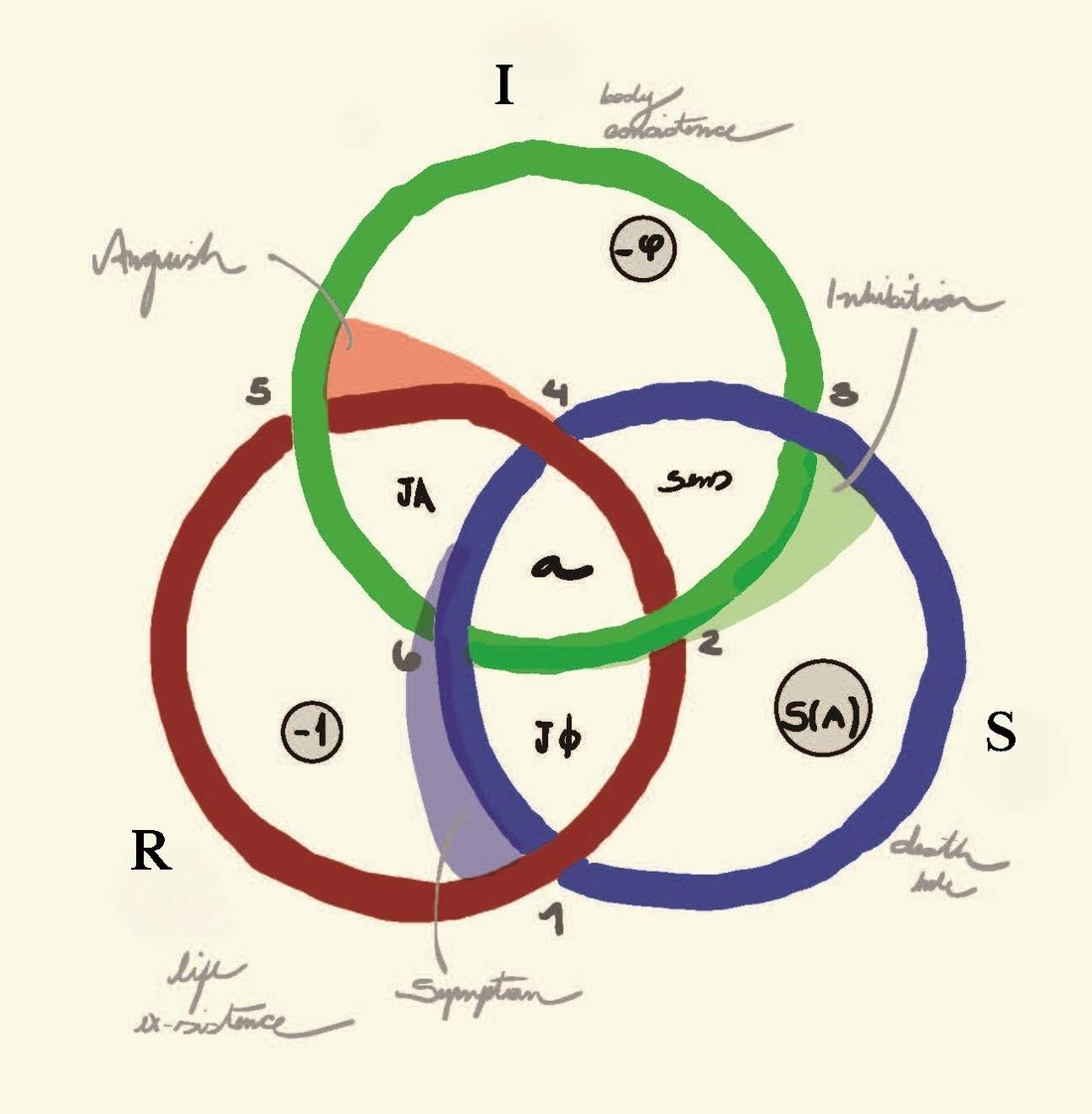
In the above diagram, you will see the three registers (Real, Symbolic, and Imaginary) arranged in a Borromean configuration (meaning that while no two rings are interlocking with one another, the three as a totality are interlocking; if one of the rings is cut and “set free,” so are all of the rings unchained). Additionally, you will notice the delineation of specific territories where the different registers overlap and intermingle with one another. Moving from left to right, we can locate the following territories of jouissance:
JA — Jouissance Autre (Other Jouissance)
Location: juncture of the Real and the Imaginary
JΦ — Jouissance Phallique (Phallic Jouissance)
Location: juncture of the Symbolic and the Real
Sens — Jouissance du sens (Joui-sense or Jouissance of Meaning)
Location: juncture of the Imaginary and the Symbolic
Essentially, I want to suggest that these distinct fields of jouissance are different spacetimes inhabited by the subject (it is equally true to say that the subject is inhabited by them!) and that these modes of jouissance qua spatiotemporalities can be correlated with the smooth and striated framework developed by Boulez. The rest of this current essay will be dedicated to demonstrating these correlations.
Sense and Inhibition
We can begin with the field of meaning (the jouissance of sense, at the intersection of Symbolic and Imaginary), which I postulate to be a territory characterized by a maximal degree of striation. Here the signifier and signified meet and intermingle under the aegis of the big Other (whose lack is occluded), with the consistency of the Imaginary working to further reinforce the effect of coherence. The movements possible within such a spacetime are always limited to a finite set of variants given in advance. To conceptualize this space musically, we can imagine a composition whose transmutations lawfully adhere to a predetermined system of harmonic and melodic development and whose time feel is governed by the functions of pulse and meter.
In this field, the subject produces sense, which confers stability upon his or her lifeworld. In certain instances, this sense will be marshaled to defend the subject against the lack in the Other (represented in the diagram by the hole containing the symbol S(A)) and/or the -φ of castration (found in the hole of the Imaginary). That is to say, meaning is often produced in an attempt to restore cohesion and solidity when the subject is forced to contend with the incoherence of the social order (i.e. the lack in the Symbolic) or the lack in the subject him or herself. Notably, the field of sense is proximate to the region denoted as inhibition, where the Imaginary encroaches upon the register of the Symbolic. What to make of this juxtaposition? Could we say that the production of sense—by way of the interlinking of Symbolic and Imaginary processes—carries the risk of a disequilibrium, wherein the pressure for imaginary coherence and meaning becomes so great that the movement of the signifiers is impeded?
Other Jouissance and Anguish
Turning to the other end of the spectrum, we can correlate the field of the Other jouissance (at the crossing of Real and Imaginary) with the Boulezian notion of smoothness. Crucially, this mode of jouissance operates outside the purview of the Symbolic. I don’t take this to mean that language as such has no bearing on this territory of the subject; rather, it seems to me that signifiers indeed have a function in this domain, but that their articulation need not accord with the conventions that govern the Symbolic order. At an extreme, this is the domain in which the linking of S1 to S2 (master signifier and elaborated knowledge) might be superseded by a series of S1s that do not form a chain. Alternatively, there might occur segments of chained signifiers that produce heterodox patterns impervious to the normative dictates that accrue to the processes of signification within the domain of the Symbolic. Here in the field of the Other jouissance, poetic effects abound. Equally though, it’s the realm of that which eludes language, of dynamics of body and being that do not find their way into the signifier at all. From time to time in this territory, we can only echo Arthur Eddington and say “something unknown is doing we don’t know what.”
Imagined musically, the Other jouissance would constitute a sonic landscape recalcitrant to preordained structure both in terms of pitch (where unanticipated frequencies and intervals would readily emerge) and rhythm (where time would be “amorphous” and without pulse, musical events occurring in a temporality that defies metricity or predictability). What is produced in the field of the Other jouissance? The surprising, the unprecedented, the singular. As Deleuze and Guattari aptly observe, “all becoming occurs in smooth space.”2
As in the case of sense (which is juxtaposed to inhibition), the Other jouissance is also proximate to a dynamic interplay wherein one register encroaches upon another. In this instance, we are dealing with anguish, which represents the incursion of the Real into the Imaginary. I take this to indicate that while the Other jouissance is characterized by a high degree of entropy, it is not without its own internal dialectic of orderliness, receiving at least a modicum of coherence from the influence of the Imaginary. Anguish, on the other hand, would constitute a moment of maximally entropic potential within the dynamical system of the subject, where not only does the subject not have recourse to signifiers, but where even the fundamental substrate of bodily consistency is threatened by the intruding force of the Real.
Phallic Jouissance and the Symptom
As we move our attention to the field of phallic jouissance (where the Symbolic and the Real interpenetrate), the dialectic of smooth and striated takes on a different form of intricacy. In this territory the subject produces endless iterations of signifiers, desires, and strivings which paradoxically return him or her to the same place: the scene of the fundamental fantasy. Phenomena that initially appear to manifest entropic novelty reveal themselves to be variations on a relatively static motif that underpins and orders the movements that occur in this region of subjectivity. Appropriately, this is the domain of the classical formations of the unconscious (the dream, the slip, the parapraxis) and of repetition in its fullest Freudian sense. A musical analog for this form of jouissance might be a structure of apparent randomness in pitch or rhythm that periodically exposes its highly striated organizing principles. Alternatively, we can imagine a melodic-harmonic development generally characterized by a high degree of unpredictability but punctuated by repetitive leitmotifs or refrains.
Phallic jouissance neighbors the symptom, a dynamic incursion of the Symbolic into the Real. I am tempted to think of the symptom as a kind of overflow of phallic jouissance resulting from the stifling of the truth that is articulated in the motif of the fantasy. When repression operates to a degree of intensity that it impedes the movement of desire in accordance with the logic of the fantasy, the symptom is the recourse for the repressed truth. The symptom is always a conversion (not just in the sense given this term by Freud in his work on hysteria)—a conversion of the fantasmatic truth of phallic jouissance to another form. The refrain is transposed to a new key, we could say. Or a better representation might be to imagine a melody which, after finding no receptive ear, resorts to a synesthetic leap to a different sensory pathway—becoming a color, for instance.
Polyphony and Polyrhythm
The utility of this model hinges upon the clinician’s capacity to mantain a dynamic perspective—that is, to conceptualize the different modes of jouissance (as well as the correlated phenomena of inhibition, symptom, and anguish) as perpetually in motion and in interaction with one another. The clinician must aspire to hold a dialectical tension comprised of local and global effects, attending not only to the dynamics within each territory but also to the evolving gestalt of the system as a totality. There is always an interplay of resonance and response, of event and counterevent, of compensations, attenuations, amplifications, feedback loops…
For instance, on certain occasions we witness what appears to be a reciprocal exchange between the smooth and the striated: when an intensification of Other jouissance provokes a compensatory response in the domain of sense. Plunged headlong into the entropic and ineffable, the subjective economy converts the surfeit of Other jouissance into anguish, causing the subject to attempt a restabilization by way of meaning. He or she fortifies a conceptual system that becomes ever more rigid but is nevertheless haunted by the enigmatic echoes reverberating from the field of the Other jouissance. Deleuze and Guattari had already gotten a hold of this insight when they cautioned that if one is too reckless in the leap into the domain of the body without organs (which I correlate with the Other jouissance) that a countervailing consolidation and solidification might occur, with fascistic implications.12 In essence, what Deleuze and Guattari think of as the line of flight of the “schizo”13 can—if the conditions of the flight are less than optimal—result in a psychic backlash of paranoia. Here it should be noted that paranoia can be linked to instances where the striations of sense are intensified to the point of fearful hostility toward any phenomenon that does not accord to the grid of a totalizing meaning.
The clinician’s conception of the interplay of the modes of jouissance (the possible iterations of which are vast) should not however confine itself to the expectation that all three forms of jouissance will be operative in every subject at all times. In fact, one of the further advantages of this model is that it might help the clinician to attend to instances wherein a particular field of jouissance becomes unavailable within the subjective economy at a particular moment. In certain cases we can theorize an occlusion of one or more of the avenues of jouissance (either from topological events occurring within a Borromean configuration, or from the loss of the Borromean configuration as demonstrated by Lacan in Seminar 23 14). These occlusion can be brief, long-term, or can even exhibit a rhythm of periodicity.
Whomever we are working with, we can presume that we are encountering an array of spacetimes which comprise a dynamical system. Striated rhythms are punctuated by smooth syncopations. Amorphous landscapes are coexisting and interacting with highly intrincate, labyrinthine grid-like configurations. There are leitmotifs and refrains scattered about in the evolving music of the psyche, intensifications of force and density, openings into hollow canyons where the reverberations accumulate. The analytic process contributes to the mapping of these evolving territories while being inextricably entwined in those territories themselves.
Notes
- Boulez, P. (1971). Boulez on music today (S. Bradshaw & R. R. Bennett, Trans.). Harvard University Press. ↩
- Deleuze, G., & Guattari, F. (1987). A thousand plateaus (B. Massumi, Trans.). University of Minnesota Press. (Original work published 1980) ↩
- Deleuze, G. (2007). Two regimes of madness: Texts and interviews 1975-1995 (A. Hodges & M. Taormina, Trans.; D. Lapoujade, Ed.). Semiotext(e). ↩
- In fact, there are musical systems that resemble this mythical piano that we’ve just imagined. In my music school days, I studied one such microtonal system in a class taught by Joe Maneri, who at that time was doing a lot of composing using a 72-note scale (remember, the Western system employed by everybody from Beethoven to the Beatles is a 12-note scale)! ↩
- Credit is due to my colleague Benoît Le Bouteiller for helping to clarify the correspondence between the smooth/striated dialectic and the mathematical concepts of continuous and discrete functions. ↩
- Here I am of course thinking of this term’s use within physics, wherein, following the implications of Einstein’s theory of general relativity, space with its three dimensions and time as the fourth are rendered inextricable, together forming the spacetime continuum. ↩
- Lacan, J. (1972). L'Etourdit (J. Stone, Trans.). Retrieved from http://www.freud2lacan.com ↩
- Lacan, J. (1978-1979). Seminar 26: Topology and Time (D. Collins, Trans.). Retrieved from http://www.apwonline.org ↩
- Lacan, J. (1972-1973). Seminar XX: Encore (On Feminine Sexuality, The Limits of Love and Knowledge) (B. Fink, Trans., 1998). W.W. Norton & Company. ↩
- Lacan, J. (1974-1975). Seminar XXII: RSI (Gallagher, Trans.). Retrieved from http://www.lacaninireland.com ↩
- Lacan, J. (1974). The Third (La Troisième) (P. Dravers, Trans.). In Get Real (The Lacanian Review, Issue 7). ↩
- Deleuze, G., & Guattari, F. (1972/2009). Anti-Oedipus: Capitalism and schizophrenia (R. Hurley, M. Seem, & H. R. Lane, Trans.). Penguin Books. ↩
- A term they never employ in the pejorative sense. ↩
- Lacan, J. (1975-1976). The seminar of Jacques Lacan. Book XXIII: The sinthome (A. R. Price, Trans., 2016). Polity Press. ↩